Contracts at the Edge of the World
In 1847, a whaling ship called the Meridian left New Bedford, Massachusetts, bound for the Pacific. The voyage was supposed to last three years. It lasted five.
By the time the ship reached the Azores on its way home, the original agreement between captain and crew had become meaningless. Men had died. Others had been picked up from shipwrecks. The cargo hold was full of oil that would make the owners rich, but the men who had harvested it were operating on a contract that hadn't anticipated any of what had happened.
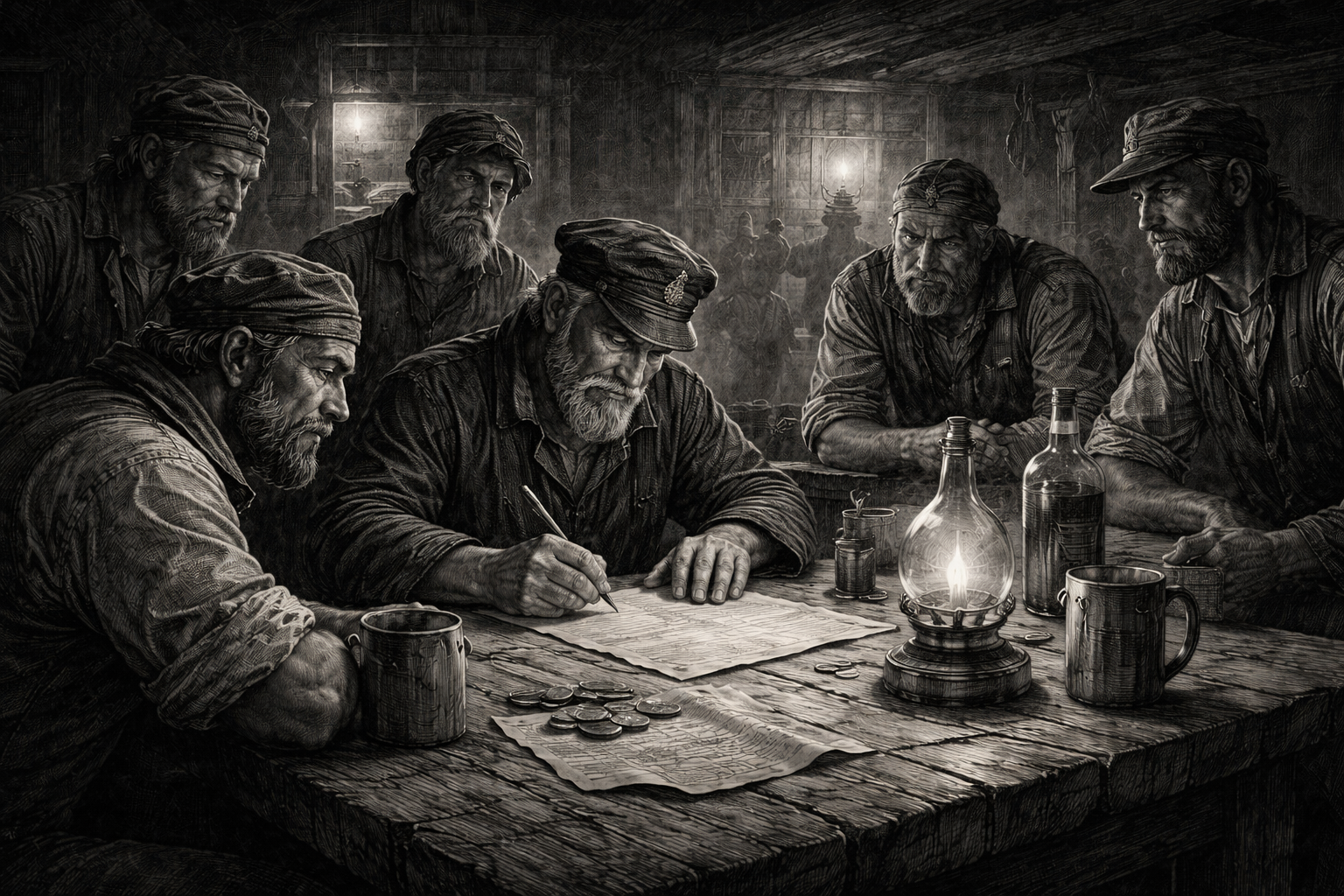
In a port tavern, the captain and surviving crew sat down to write a new agreement. They had no lawyers. No witnesses except each other and a Portuguese barkeeper who couldn't read English. Just a piece of paper, a pen, and the understanding that they needed to get things straight before they sailed the final leg home.
That piece of paper — smudged, water-stained, signed by men whose hands were more used to harpoons than pens — is now in a maritime museum in Massachusetts. It's one of the purest contracts I've ever seen described. No legal language. No liability clauses. Just: here's what happened, here's what everyone gets, and here are our names at the bottom.
Why We Write Things Down
People think contracts exist because we don't trust each other. That's not quite right.
Contracts exist because memory fades. Because circumstances change. Because what seems obvious today will seem murky in six months. Because people die, and the people who come after need to know what was agreed.
A handshake is beautiful. I've made plenty of them myself, here in the lighthouse, with the supply boat captains and the occasional researcher who needed a favor. But a handshake lives in the minds of two people, and minds are fragile. They forget. They rewrite. They see the past through the lens of the present.
Writing it down isn't distrust. It's kindness to your future self. It's saying: I know we both understand this now, but let's make sure we still understand it later.
The sailors on the Meridian didn't write that contract because they distrusted each other. They'd survived five years together. They were closer than brothers. They wrote it down because they knew the owners back in New Bedford would have questions, and they wanted the answers to be clear.
The Law of the Sea
Maritime law is some of the oldest contract law in the world. The Rhodian Sea Law dates back to 800 BC. The Rolls of Oléron — the foundation of admiralty law in the Atlantic — were compiled in the 12th century.
These weren't laws written by legislators in comfortable chambers. They were rules developed by sailors, merchants, and captains who needed to solve real problems in real time. What happens when a ship is damaged and cargo must be thrown overboard? How do you divide salvage rights? What are the obligations of a captain to his crew?
The solutions they developed were remarkably simple. If cargo must be jettisoned to save a ship, all parties share the loss proportionally. If a sailor is injured in service, he's entitled to care and compensation. If a captain abandons his crew, he forfeits his share.
These rules worked because they were clear. You could explain them to an illiterate deckhand in five minutes. You didn't need a lawyer to interpret them.
Somewhere along the way, we lost that clarity. Contracts became documents that only specialists could read. The simple question — what did we agree to? — became buried under pages of definitions, clauses, and cross-references.
I don't think the sailors of the Meridian would recognize what we've done to the contract. They'd look at a modern terms of service agreement and wonder who we were trying to confuse.
Agreements on the Ice
Out here, at the edge of the world, contracts take different forms.
The supply boat captain and I have an understanding. He comes twice a year, weather permitting. He brings what I've ordered, plus a few extras he thinks I might need. I pay the company rate, plus a little extra for his trouble. If conditions are bad, he doesn't risk his boat or his crew — and I don't blame him for it.
None of this is written down. It doesn't need to be. We've been doing this for thirty years, and the arrangement has never changed enough to require clarification.
But that's the exception, not the rule. It works because we see each other, because we've built trust over decades, because the stakes are relatively low. If he doesn't show up, I have reserves. If I don't pay, he knows where to find me.
Most of the world doesn't work that way. Most agreements are between people who don't know each other well, who won't see each other regularly, who need something more durable than memory and goodwill.
For those agreements, you need paper. Or whatever passes for paper these days.
The Gift of Clarity
A few years ago, a research team came through Kråkeholm. They were studying ice patterns, something to do with climate change. They needed to use part of the lighthouse as a base station for their equipment.
The team leader was a young woman from a university in Denmark. She was apologetic, almost embarrassed, when she handed me the contract. "I know this seems formal," she said. "It's just the university requires it."
I read it. It was two pages. It explained what equipment they would install, where they would put it, how long it would stay, what they would do if something got damaged, and what I could do if I needed them to remove it. It was written in plain language. I understood every word.
I signed it happily. Not because I distrusted her — she seemed perfectly honest — but because the document was a gift. It meant I didn't have to wonder. It meant neither of us would misremember. It meant if something went wrong, we had a reference point.
That's what a contract should be. Not a weapon. Not a trap. Not a maze of legal language designed to obscure rather than clarify. Just a clear statement of what we agreed to, signed by the people who agreed to it.
The Burden We've Added
The problem isn't contracts. The problem is what we've turned contracts into.
I hear stories from my nephew, the contractor in Denmark. He tells me about clients who agree to everything verbally, then take three weeks to return a signed contract because the signing process is so cumbersome. Create an account. Verify an email. Log in through some system. Navigate to the right page. Sign in five different places. Initial here, here, and here.
By the time they're done, they've forgotten what they were agreeing to. The signing process has become so laborious that it overshadows the agreement itself.
This is backwards. The contract should take thirty seconds. Read it, sign it, done. The time and attention should go to the actual work — the project, the relationship, the thing that matters.
Instead, we've built systems that make the paperwork more memorable than the partnership. We've turned the means into the end.
What the Old Sailors Knew
The men on the Meridian knew something we've forgotten: a contract is a tool, not a monument.
They wrote their agreement in a tavern, in an hour, with language anyone could understand. They signed it and got on with their lives. The contract existed to serve them, not the other way around.
We need to get back to that. Tools that make agreements easy. Language that makes terms clear. Processes that take seconds, not hours.
The contract is one of humanity's oldest inventions. It deserves better than what we've done to it. It deserves to be simple again.
The supply boat comes in April. When it arrives, I'll shake Captain Henriksen's hand like I always do. We'll share a coffee and talk about the weather and the ice and whether the fishing's been any good. Then he'll hand me a clipboard with a form to sign — confirmation of delivery, required by the company — and I'll sign it without thinking.
But the real agreement between us isn't on that paper. It never has been. It's in thirty years of showing up when we said we would. The paper is just a formality. The trust is what matters.
That's how it should be.
Gilberto Mares has been keeper of the Kråkeholm Light for fifty years. He writes about time, tools, and the things that matter. He does not have a smartphone.