What the Fog Teaches You About Trust
The fog comes without warning here.
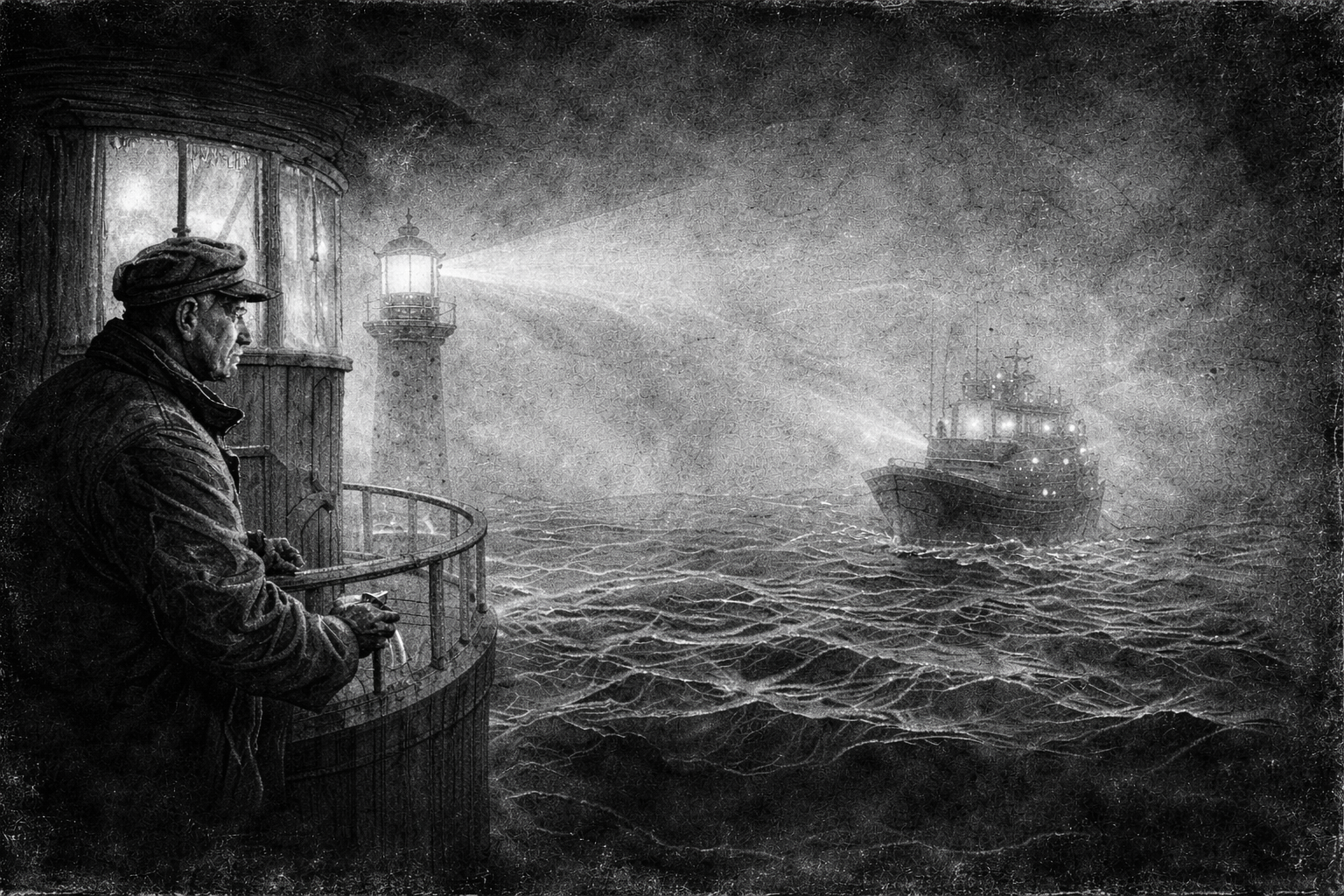
One moment, the sea stretches to the horizon, steel-gray and infinite. The next, you can't see the rocks twenty meters below. The world contracts to the tower, the lamp, the small circle of light that pushes uselessly against the white.
Ships don't stop for fog. They can't — schedules to keep, cargo to deliver, crews to bring home. So they navigate blind, trusting the instruments, trusting the charts, trusting that the lighthouse keeper on some frozen rock is doing his job.
They can't see me. They don't know my name. They have no guarantee that the light will be on or that it's pointing them in the right direction. They only have trust.
Fifty years of keeping this light, and that still humbles me. Every foggy night, strangers put their lives in my hands without ever shaking one.
The Nature of Trust
Trust is not the absence of doubt. It's acting despite doubt.
When a ship enters the fog, the captain doesn't stop doubting. He doubts the weather will hold. He doubts the charts are perfectly accurate. He doubts whether that blip on the radar is another vessel or just noise. Doubt is a sailor's constant companion.
But he acts anyway. He keeps moving, keeps navigating, keeps trusting that the systems he depends on will function as expected. Trust isn't about certainty. It's about being willing to proceed without it.
I think about this when people talk about contracts and trust as opposites. "If you really trusted me, we wouldn't need a contract." I've heard this sentiment more times than I can count, usually from people who are about to cause problems.
It misunderstands what trust is. Trust isn't naive faith that nothing will go wrong. Trust is confidence that when something does go wrong, there's a framework for dealing with it.
The captain trusts the lighthouse not because he's certain it will never fail, but because he knows what it's supposed to do and can plan accordingly. The light provides a reference point. Without it, he's guessing.
Contracts work the same way.
Trust Is Built Slowly
There's a supply boat captain I've worked with for thirty years. His name is Henriksen. We've never signed a contract between us — not a real one, just the delivery receipts his company requires.
That's thirty years of trust, built one delivery at a time.
The first year, I watched him carefully. Did he bring what he said he'd bring? Did he arrive when he said he'd arrive? Did he charge what he quoted? Each successful exchange was a small deposit in an account I couldn't see but could feel.
By year five, I stopped checking the manifests so carefully. By year ten, I told him to just bring what he thought I needed and I'd pay whatever seemed fair. By year twenty, I gave him the spare key to the supply shed in case I was up in the lamp room when he arrived.
That trust took decades to build. And I'm under no illusion that it can't be broken. One bad winter, one failed delivery, one serious disagreement about money — and we'd be back to checking manifests. Trust isn't permanent. It's maintained.
Most business relationships don't have thirty years to develop. They need to function from the beginning, between people who've never met, who may never meet, who have nothing but a transaction between them.
That's what contracts are for. They're a shortcut to workable trust. Not the deep trust of old friends, but the practical trust of clear expectations.
Contracts as Bridges
A good contract is a bridge.
It connects two parties who might otherwise have no way to work together. It lets strangers cooperate by defining what each party will do, what happens if they don't, and how disputes will be resolved.
Without the bridge, you need either deep personal trust (which takes years) or constant supervision (which is expensive and exhausting). The contract gives you a third option: documented agreement.
The best contracts I've seen are short, clear, and feel almost unnecessary. Both parties understand what they're agreeing to. Both parties intend to follow through. The contract exists not because they distrust each other, but because memory is imperfect and circumstances change.
"I think we both understand what we're agreeing to, but let's write it down so we still understand it six months from now."
That's a bridge. That's trust made practical.
Contracts as Weapons
But contracts can also be weapons.
I've seen it happen. A company uses a contract not to clarify terms but to obscure them. They bury unfavorable clauses in pages of legal language, hoping the other party won't read carefully. They make the signing process so burdensome that people give up trying to understand what they're agreeing to.
When something goes wrong, they pull out the contract and point to the clause that protects them. "You signed it. It's right here on page thirty-seven."
Technically correct. Morally bankrupt.
These companies have turned the contract from a tool for cooperation into a mechanism for extraction. They're not building bridges; they're laying traps.
And people notice. Once you've been burned by a contract designed to deceive, you start viewing all contracts with suspicion. The weapon damages trust even for those who would use contracts honestly.
This is why I'm suspicious of complexity. When a contract is forty pages long, when it takes a lawyer to understand the terms, when the signing process requires more effort than the actual transaction — something has gone wrong. Either the agreement is genuinely complex (rare) or someone is using complexity as cover (common).
The fog doesn't hide friends. It hides dangers.
The Lighthouse Principle
Here's what fifty years of keeping a lighthouse has taught me about trust in business:
A good tool gets out of the way. The lighthouse doesn't demand attention. It doesn't require ships to stop and admire it. It does its job — provides a reference point — and lets ships proceed. Contracts should work the same way. Document the agreement, then disappear. If your signing process takes longer than the conversation that led to it, something is wrong.
Reliability beats brilliance. Ships don't need a lighthouse that's spectacular sometimes. They need one that's adequate always. The light at Kråkeholm isn't the brightest in the North Atlantic. But it's been on every night for over a century. In business, the company that shows up consistently beats the company that impresses occasionally.
Trust is a record. Every time I keep the light on, I'm making a small deposit in an account I share with every ship that passes. Every time a company honors a contract fairly, they're building a reputation that makes future contracts easier. Trust isn't a feeling. It's an accumulation of kept promises.
Clarity protects everyone. The lighthouse works because ships know what to expect. The light is here. It flashes at this interval. It marks this position. When expectations are clear, both parties can plan accordingly. When expectations are murky, everyone's guessing.
The Trust Thermometer
I've developed a simple test for whether a contract is a bridge or a weapon.
After reading it, ask yourself: does this make me trust the other party more, or less?
A bridge contract makes you think, "These people have been clear about what they want and what they're offering. We're aligned." You feel better about the relationship after reading the terms.
A weapon contract makes you think, "What are they trying to protect themselves from? What are they worried I might do?" You feel worse about the relationship. You start wondering what else they might be hiding.
The best contracts I've ever signed left me feeling respected. The terms were fair, the language was clear, and the process was simple. The contract said, implicitly, "We trust you enough to make this easy."
That's the kind of contract that builds relationships. That's the kind of contract that turns strangers into partners.
Through the Fog
The fog will lift eventually. It always does. And when it does, the ships that trusted the light will find themselves exactly where they expected to be — safely past the rocks, on course, ready for the next leg of the journey.
That's what good tools do. They help you get through the uncertain parts so you can reach the clear ones.
Contracts at their best are fog lights. They illuminate just enough to keep moving. They don't pretend to eliminate all uncertainty — nothing can do that — but they reduce it to manageable levels.
Twenty-five cents to send a contract. Clear terms, simple process, sign and move on. That's not cutting corners on trust. That's respecting it.
Because trust isn't built by making things complicated. It's built by showing up, doing what you said, and making it easy for others to do the same.
The light's always on. That's the only promise I've ever needed to keep.
The fog is coming in again as I write this. I can see it building on the horizon, a white wall advancing across the water. In an hour, it will be here. In two hours, I won't be able to see the sea.
But the light will be on. Whatever ships are out there will have their reference point. And tomorrow, when the fog lifts, they'll be where they need to be.
That's enough. That's always been enough.
Gilberto Mares has been keeper of the Kråkeholm Light for fifty years. He writes about time, tools, and the things that matter. He does not have a smartphone.